Home by the Bay
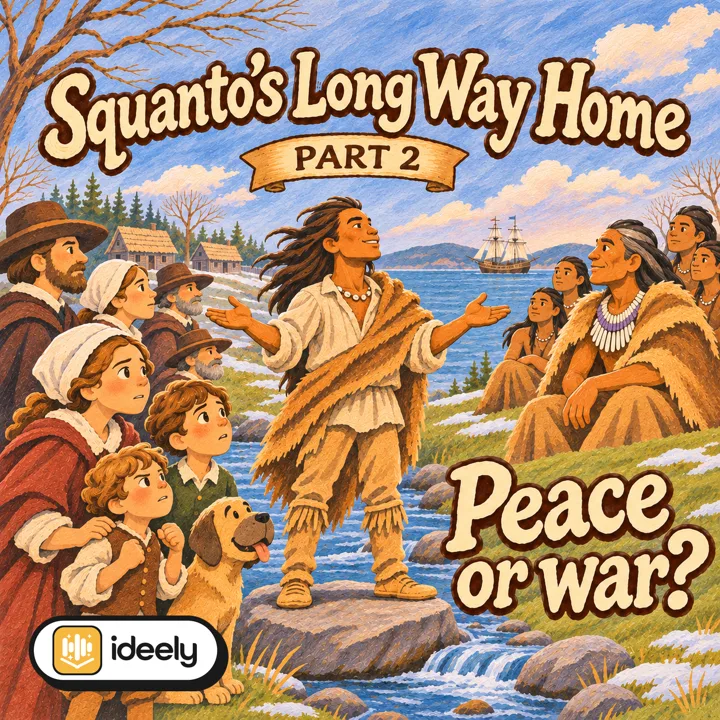
Narrator: Squanto's Long Way Home. Episode one. Stolen Away. It was a cold, gray morning in the spring of 1621. In a tiny English village by the sea, two brothers peeked around the corner of a log house. Their names were Love and Wrestling. Yes, really. Love was nine. Wrestling was six, and he wanted to wrestle everything.
Wrestling: Love. Somebody's coming out of the woods.
Narrator: A tall man walked across the field, straight toward the village. The grown-ups froze. Nobody knew who he was. Nobody knew if he was a friend. And then the man opened his mouth, and spoke to them... in perfect English.
Love: How does he know our words?
Wrestling: I could wrestle him.
Love: Please don't.
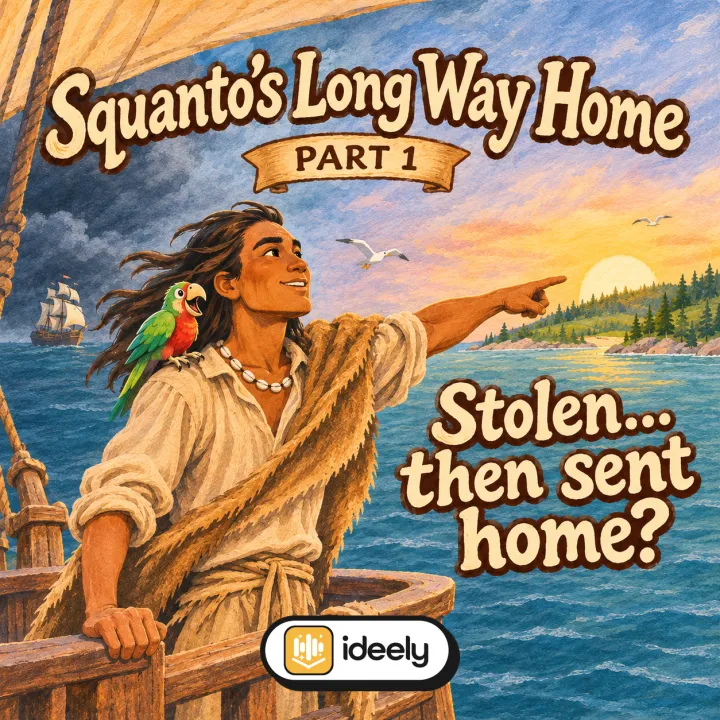
Narrator: How could a man from this faraway land know English? To find out, we have to go back seven years, and all the way across a very big ocean. Because this is a story of two journeys. And the first one belongs to him. Summer, 1614. On the shore of a sparkling bay stood a village called Patuxet. Corn fields climbed the hills. A cold, clear brook ran down to the sea. And in the mud by the water stood a young man named Tisquantum. Most people today call him Squanto.
Squanto: Watch this.
Narrator: Squanto wiggled his bare toes down into the mud. Squish. Squish. Then, quick as a heron, he plunged in his hands and pulled up a long, wriggling eel.
Squanto: Ha! Got you! Hey. Hey! Not in the face!
Narrator: Squanto laughed and carried his supper home past the corn fields. When he was a little boy, his grandmother had shown him how to plant them.
Grandmother: Three sisters, little one. Corn grows tall. Beans climb up the corn. Squash spreads her big leaves to keep the ground cool. Sisters help each other.
Narrator: Every spring, the brook at Patuxet filled with so many silver fish that the water looked alive. The children splashed in to catch them with their hands, shrieking and laughing, and Squanto always caught the most.
Squanto: Too slow, little ones! The fish are laughing at you!
Narrator: That summer, two English ships sailed into the bay. One captain, named John Smith, drew careful maps of the coast. On his map, he wrote a new English name right where Patuxet was. Can you guess what he called it? Plymouth. Remember that name. Then he sailed back to England. The other captain, Thomas Hunt, stayed behind. Captain Hunt smiled a big smile. He invited the men of Patuxet onto his ship to trade.
Captain Hunt: Come aboard, friends! Come and see what we have!
Narrator: Squanto and about twenty other men climbed aboard. But when they stepped down into the bottom of the ship, the door slammed shut. Bang. The ship began to move. It rocked, and creaked, and sailed away from Patuxet. Away from the cornfields. Away from home. Down in the dark, the men held on to each other as the ship tossed up and down. Squanto closed his eyes and remembered his grandmother's words.
Squanto: Sisters help each other. Brothers too. Hold on. Hold on to me.
Narrator: Captain Hunt meant it for evil. But here is something you need to know. Can you say it with me? But God saw. And God was not finished yet. Say it once more. But God saw. And God was not finished yet.
Far Across the Sea
Narrator: For weeks the ship sailed east. When the door finally opened, Squanto blinked in the hot, bright sun. He was in Spain, in a city called Málaga, full of church bells and orange trees. Captain Hunt planned to sell the men as slaves. But then, men in long brown robes pushed through the crowd. They were friars, men who served God. And they took some of the stolen men away, to care for them. One friar, Brother Andrés, gave Squanto bread, a blanket, and a job in his garden. Brother Andrés talked to his plants. Every single one.
Brother Andrés: Good morning, Rosa. Good morning, Miguel. Patience, little Pedro. You will grow when you are ready.
Squanto: Do the plants answer you?
Brother Andrés: Not yet. Here. Taste an orange.
Narrator: Squanto bit into the orange, and it squirted him right in the eye.
Squanto: Your fruit fights back!
Narrator: Brother Andrés held up a tiny seed.
Brother Andrés: Jesus said a seed has to go down into the dark ground before it can grow. It looks like the end. But it is not the end.
Narrator: That night, under the stars, Brother Andrés told Squanto a story from the Bible. A story about a boy named Joseph, who had a bright, beautiful coat, and brothers who were jealous. His brothers threw Joseph into a deep, dry well. Then they sold him to traders, who carried him far away to Egypt, a land where he didn't know anyone and couldn't speak the language. Joseph was a slave. Then he was put in prison for something he didn't do.
Squanto: Sold far away. Where nobody speaks your words.
Brother Andrés: Yes. Just like you. But listen to what happens.
Narrator: But God was with Joseph the whole time. And one day, Joseph became a ruler in a palace, and he saved many, many people from hunger. Even his brothers. Joseph forgave them, and he said:
Brother Andrés: You meant it for evil. But God meant it for good.
Squanto: Could God do that... for me?
Brother Andrés: God knows your name, Tisquantum. Even here.
Squanto: Then I will find my way home.
Narrator: Nobody knows exactly how, but somehow Squanto made his way to England, to the giant, noisy city of London. He lived in the house of a merchant named John Slany. And Squanto had a plan.
Squanto: If I learn their words, I can ask them to take me home.
Narrator: London was the most amazing place Squanto had ever seen. A bridge so big, people built houses right on top of it. Real lions, kept in a castle called the Tower. And men who wore white ruffled collars around their necks, as big as dinner plates. Mister Slany also had a parrot. Her name was Pepper. And Pepper learned Squanto's words faster than Squanto learned English.
Pepper: Ask them to take me home! Squawk! Home! Home!
Squanto: Pepper. Say it again. Slower.
Pepper: Squaaawk.
Narrator: Learning English was hard. Squanto mixed things up all the time. One morning he tried to say "good morning" to Mister Slany, and it came out as something else entirely.
Squanto: Good... pudding, Mister Slany!
Mister Slany: Close, Squanto. Very close.
Pepper: Good pudding! Good pudding! Squawk!
Narrator: Word by word, Squanto learned English. And every night at dinner, he asked the same question.
Squanto: Mister Slany. When can I go home?
Mister Slany: Soon, Squanto. Soon.
The Long Way Home
Narrator: At last, Squanto sailed west, first to an icy land called Newfoundland, where the sea was so full of codfish that sailors scooped them up in baskets. It was so cold there that Squanto's breath turned to clouds and the ropes on the ship froze stiff. But every day was one day closer to home. There he met a captain named Thomas Dermer, who was planning a voyage to Squanto's land.
Squanto: Captain, you are sailing to my land. You need someone who knows the words. I know the words.
Captain Dermer: Hmm. Then you'd better come along.
Narrator: In the year 1619, five long years after Captain Hunt's trap, the ship sailed down the coast. And Squanto knew every bay.
Squanto: That way! Left! No. Your other left.
Narrator: He could almost smell the pine trees. He could almost hear his grandmother calling. Squanto jumped from the boat and ran up from the beach toward Patuxet. But Patuxet was quiet. Too quiet. The fields had grown over with weeds. The houses were empty. While Squanto was gone, a terrible sickness had come, a sickness his people had never had before. Probably it came on the sailors' ships. And it took everyone. Squanto was the last of the Patuxet. He walked through the quiet village. Past the empty houses. Past the hill where his grandmother had planted the three sisters. Now there were only weeds, and the wind, and the sound of the brook.
Squanto: Grandmother? Anyone?
Narrator: Squanto sat down by the brook and cried. And here is something true. The Bible says God keeps track of all our tears, as if he saves every one of them in a bottle. God saw every one of Squanto's tears. Squanto went to live with another group of his people, the Wampanoag, and their great leader, Massasoit. But they weren't sure they could trust a man who had lived so long with the English.
Squanto: Why, God? Why did you bring me all this way... to an empty home?
Narrator: Do you remember what to say? But God saw. And God was not finished yet. The brook was still running. And as Squanto watched, a few little silver fish flashed in the water. Squanto didn't know it yet, but God was already at work. Far across the ocean, in a secret attic in Holland, a man was hiding from the king of England. His family was getting ready for a long, dangerous trip. And his little boy, named Wrestling, wanted to wrestle... everything. Squanto's journey: home, a ship, Spain, London, the cold north, and home again. The other journey? It's just about to begin.
 ideely